
The English version of this interview is at the bottom of the page
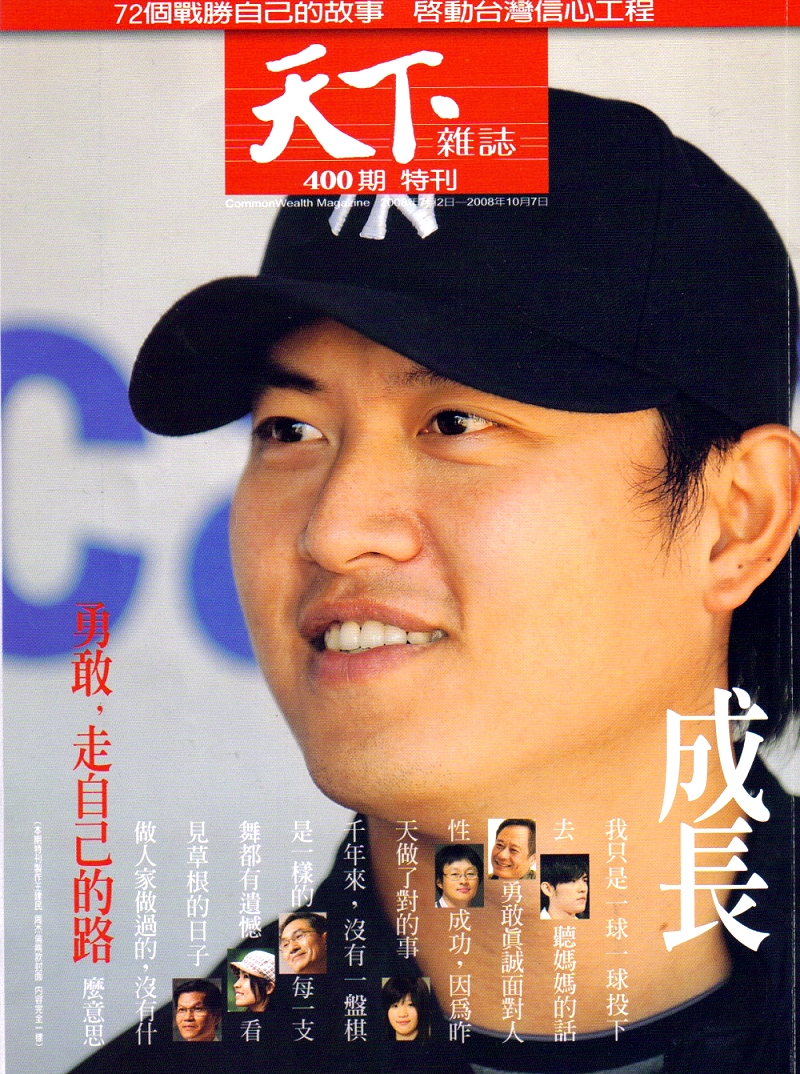
天下雜誌400期特刊 封面人物:王建民、李安、林懷民、沈芯菱……
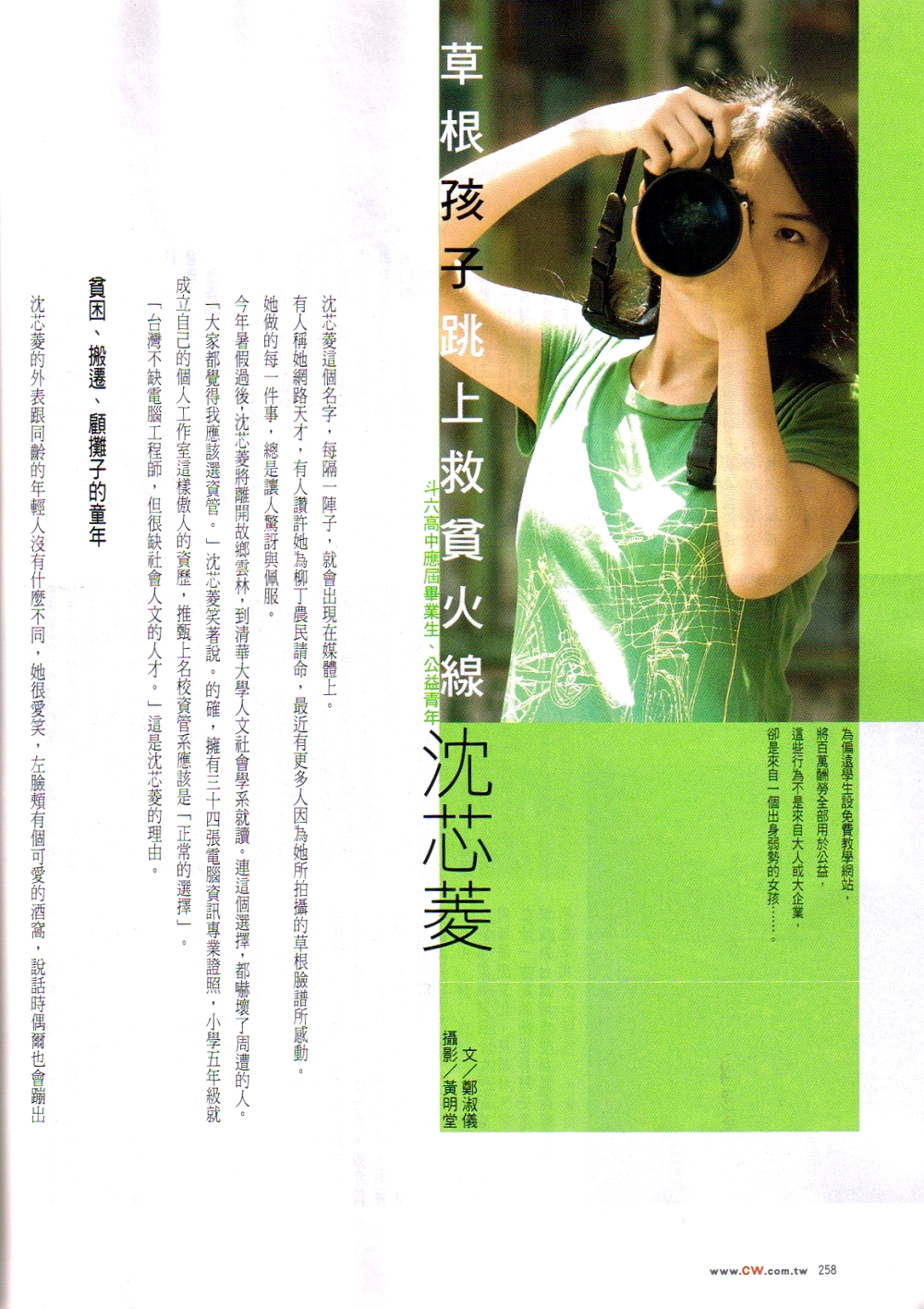
草根孩子跳上救貧火線
2008-07 天下雜誌 作者:鄭淑儀
為偏遠學生設免費教學網站,將百萬酬勞全部用於公益,這些行為不是來自大人或大企業,卻是來自一個出身弱勢的女孩……。
沈芯菱這個名字,每隔一陣子,就會出現在媒體上。
有人稱她網路天才,有人讚許她為柳丁農民請命,最近有更多人因為她所拍攝的草根臉譜所感動。
她做的每一件事,總是讓人驚訝與佩服。
今年暑假過後,沈芯菱將離開故鄉雲林,到清華大學人文社會學系就讀。連這個選擇,都嚇壞了周遭的人。
「大家都覺得我應該選資管。」沈芯菱笑著說。的確,擁有三十四張電腦資訊專業證照,小學五年級就成立自己的個人工作室這樣傲人的資歷,推甄上名校資管系應該是「正常的選擇」。
「台灣不缺電腦工程師,但很缺社會人文的人才。」這是沈芯菱的理由。
貧困、搬遷、顧攤子的童年
沈芯菱的外表跟同齡的年輕人沒有什麼不同,她很愛笑,左臉頰有個可愛的酒窩,說話時偶爾也會蹦出年輕人的語助詞。但是她的思考深度與行動力,卻異於常人,甚至超過大多數的成年人。
是什麼環境與成長過程,造就出現在的她?
雲林斗六市郊,一家小成衣廠,是沈芯菱住得最久的家。
小學以前的她,跟著父母親當流動攤販,跑遍台灣每個有夜市的角落。住過貨櫃屋、漏水的鐵皮屋,更常擠在小車裡過夜。
貧困、搬遷、顧攤子,佔滿了她的童年。但在求生存的縫隙中,沈芯菱所得到的愛與學習機會,卻不比其他孩子少。
為了償還巨額的貸款,當時除了擺攤之外,只要有錢賺的工作,他的父母都願意做。其中一個是幫寵物繁殖場送狗。
他們常開著一台一千CC的小破車,載著二、三十隻被隔在五、六個籠子裡的小狗,從南到北,送到預訂的寵物店。
小車擁擠不堪,味道更是難以忍受,但小小的沈芯菱,坐在爸爸媽媽中間,開心得像在旅行,沿途發問,這是什麼、那是什麼。「我的國字是看路上的招牌學的,」沈芯菱笑著說,「上小學的時候我不會ㄅㄆㄇ,但我已經看得懂很多國字。」
媽媽還常常到舊書攤買書,在顧攤的空檔,唸給沈芯菱聽。沈芯菱還記得,六歲的時候,媽媽在昏黃的路燈下,唸著一本字都模糊掉的《汪洋中的一條船》,講鄭豐喜奮鬥的故事。「媽媽說『我們都是海口人,他的故事,在我們那時很有名喔!』」沈芯菱回憶。
故事在斷斷續續中講完,家也在追尋溫飽中頻頻遷移,沈芯菱沒有床邊故事,但親子之間的感情,卻在街頭,更加緊密。一直到今天,那本舊書,沈芯菱還保存著,那也是影響她最深的一本書。
百萬收入全部投入公益
貧窮,讓沈芯菱懂得珍惜,淳樸而寬厚的父母,也讓「分享」的種子在沈芯菱心中漸漸萌芽。
「人要常給,不要多拿,」沈芯菱的父母常常跟她這麼說,「如果自己賺的錢都藏口袋,老天爺可以給你,有一天也會要回去。」
後來沈芯菱靠著電腦的天份與努力,小學五年級幫自己家的成衣廠架設電子商務網站,穩定客源、改善家計之後,她開始成立個人電腦工作室接案子、辦公益活動與寫書,至今所獲得的酬勞、獎金、版稅,超過一百萬元,全部投入公益。
對一個曾經負債累累、靠著攤販收入維生的家庭而言,一百萬絕對是天大的挹注。不過沈芯菱一家人,並沒有把這些錢用來購屋、擴廠甚至改善生活,而是扎扎實實的把收入跟社會分享。
現在沈芯菱的家還是租來的,陳舊的兩層樓完全沒有裝潢,樓下是成衣廠與店面,樓上是住家。前面的省道,每隔一兩分鐘,就有砂石車呼嘯而過,揚起漫天塵土。家的旁邊是一片稻田,西部縱貫鐵路穿過田間,每隔幾分鐘也會有「嗚~~嗚」的火車經過。一樓左半邊的成衣廠,其實就是三台二手的縫紉車台,三位操作車台的中年婦女是社區裡的鄰居,在這裡找到她們最好的工作,養家活口。
「上帝對窮人是最慷慨的,因為他在最飢餓的時候給他一口麵包吃,他就會覺得滿足,在最困頓的時候給他一夜好眠,他就會覺得非常愉快。」經歷過飢餓困頓、居無定所,沈芯菱對於當下,感到無比的幸福與感恩,她引述自己所看過的一部伊朗電影「心靈印記」說 。
在台灣,國小到高中這段青少年時期,獨立思考的能力,似乎總被分數與考試所淹沒。但沈芯菱不同,她認為,「學校給你的是分數,但自己要的是人生。」
在一百分與九十五分之間,她選擇九十五分,然後做自己想做的事。因為九十五到一百的距離,需要更多的心血和時間,如果把這樣的時間和心血,投入到一個零的領域,就可以從零到五十,或零到六十。
她心中「零的領域」,就是對弱勢學生的幫助。
「曾經身為弱勢,我更清楚弱勢的需要。」從小六開始,沈芯菱投入所有課餘的時間,打造她的「安安免費教學網站」,至今已超過兩百萬人次點閱,後來更延伸出中國版、柬埔寨版,幫助那些沒有錢請家教、補習或買昂貴的線上教學教材的國中小學生,自我學習。
光是虛擬的網站還不夠,沈芯菱還在自己十四歲時,獨立舉辦暑期英語學習營,號召大學生當老師,到雲林偏遠地區挨家挨戶邀請小學生參與營隊學英文。
貧窮線下的光芒
在投入公益的過程中,她的確曾感到孤獨與無力。因為師長總認為,「這是大人的事,你一個小(中)學生怎麼可能做?」而同學即使有心想幫忙,也會因為家長的反對而退出。
幸運的是,沈芯菱的父母並不像社會一般對小孩的期待要求她。
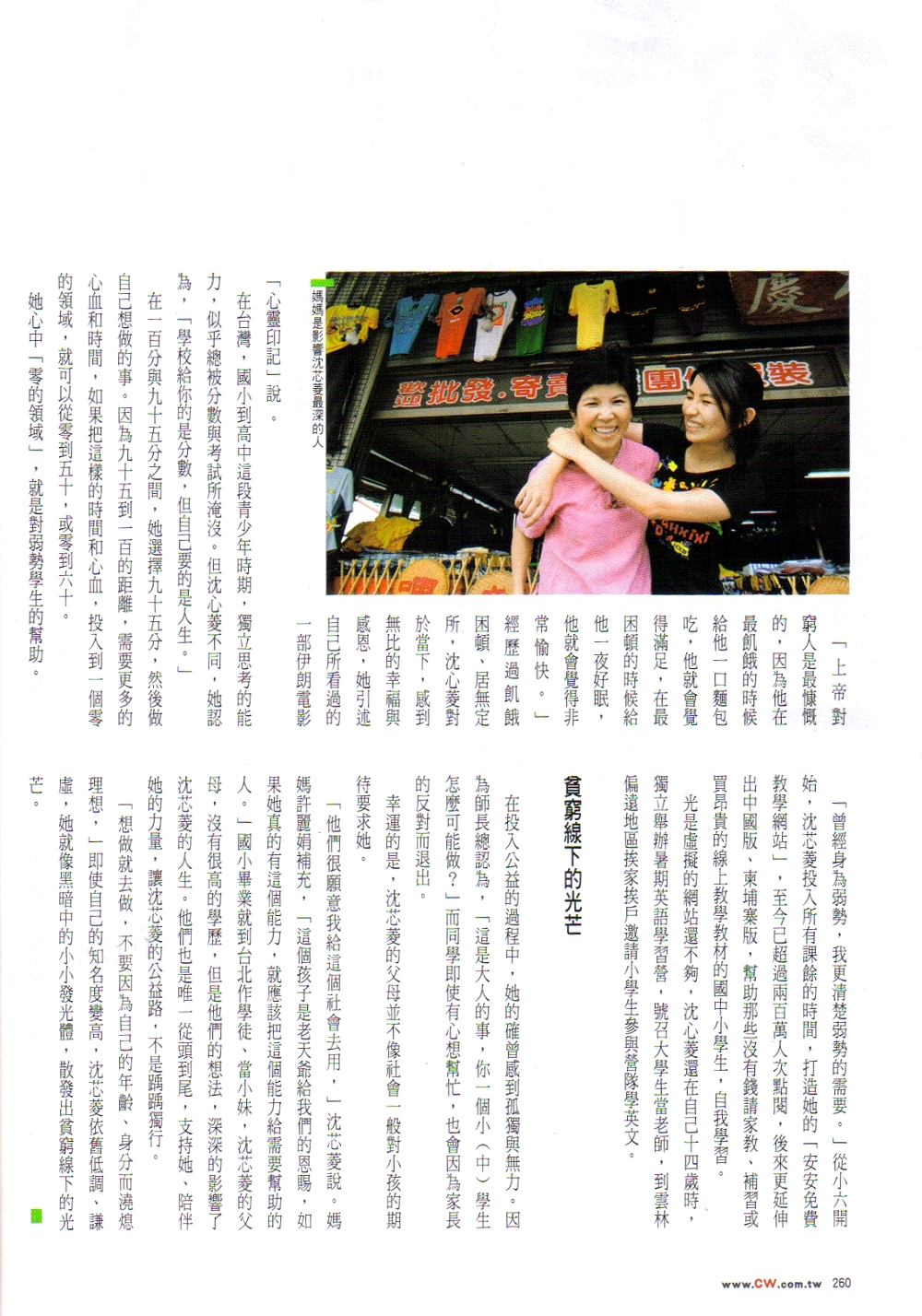
「他們很願意我給這個社會去用,」沈芯菱說。媽媽許麗娟補充,「這個孩子是老天爺給我們的恩賜,如果她真的有這個能力,就應該把這個能力給需要幫助的人。」國小畢業就到台北作學徒、當小妹,沈芯菱的父母,沒有很高的學歷,但是他們的想法,深深的影響了沈芯菱的人生。他們也是唯一從頭到尾,支持她、陪伴她的力量,讓沈芯菱的公益路,不是踽踽獨行。
「想做就去做,不要因為自己的年齡、身分而澆熄理想,」即使自己的知名度變高,沈芯菱依舊低調、謙虛,她就像黑暗中的小小發光體,散發出貧窮線下的光芒。
資料來源 天下雜誌
http://www.cw.com.tw/article/article.action?id=5002607&page.currentPage=1
Set up a free teaching website for remote students, and use all the millions of rewards for public welfare. These behaviors are not from adults or big companies, but from a girl from a disadvantaged background…
Shen Hsin-Ling (Taiwan Cinlin) appears in the media every once in a while. Some people call her an Internet genius, some people praise her for begging for orange farmers, and more people have been moved by her grassroots records recently. Everything she does is always surprising and admirable.
After the summer vacation this year, Shen Hsin-Ling will leave her hometown of Yunlin to study in the Department of Humanities and Sociology of Tsinghua University. Even this choice surprised many people. “Everyone thinks I should choose the IT field.” Shen Hsin-Ling said with a smile. Indeed, with thirty-four professional certificates in computer information, and such a proud qualification of setting up his own personal studio in the fifth grade of elementary school, it should be a “normal choice” to be selected for admission to the asset management department of a famous school. “Taiwan does not lack computer engineers, but it lacks social and humanistic talents.” This is Shen Hsin-Ling’s reason.
Shen Hsin-Ling’s appearance is no different from that of young people of the same age. She loves to laugh very much, has a lovely dimple on her left cheek, and occasionally pops out the auxiliary words of young people when she speaks. But her thinking depth and action power are different from ordinary people, even more than most adults. What kind of environment and growth process made her who she is now?
On the outskirts of Douliu, Yunlin, a small garment factory was the home where Shen Hsin-Ling lived the longest. Before elementary school, she followed her parents as a mobile street vendor and traveled to every corner of Taiwan with a night market. I have lived in a container house, a leaky tin house, and more often I have been crowded in a car overnight.
Poverty, relocation, and street stalls filled her childhood. But in the gap of survival, Shen Hsin-Ling got no less love and learning opportunities than other children. In order to repay the huge loan, his parents were willing to do any job that could make money, except for setting up a stall. One of them is delivering dogs to pet breeding farms.
They often drive a 1,000 cc small broken car, carrying 20 or 30 puppies in five or six cages, from south to north, to the reserved pet store. The car was crowded and the taste was even more unbearable, but the little Shen Hsin-Ling, sitting between her parents, was as happy as she was traveling, and asked along the way, what is this, what is that. “I learned Chinese characters from the signs on the road,” Shen Hsin-Ling said with a smile. “When I was in elementary school, I didn’t know how to read Chinese characters, but I already understood a lot of Chinese characters.” My mother often went to the used book stand to buy books, In the gap of Gu’s booth, read it to Shen Hsin-Ling. Shen Hsin-Ling still remembered that when she was six years old, under the dim street lights, her mother read a book “A Boat in the Ocean” that was blurred out, telling the story of Zheng Fengxi’s struggle. “My mother said, ‘We are all from Haikou, and his story was very famous in our time!'”
Shen Hsin-Ling recalled. The story was told intermittently, and the family moved frequently in pursuit of food and clothing. Shen Hsin-Ling had no bedside stories, but the relationship between parents and children was closer on the street. To this day, Shen Hsin-Ling still keeps that old book, which is also the book that affected her the most. All the income of one million is invested in public welfare. Poverty makes Shen Hsin-Ling know how to cherish it. Her simple and generous parents also let the seeds of “sharing” gradually germinate in Shen Hsin-Ling’s heart. “People have to give often, don’t take more,” Shen Hsin-Ling’s parents often told her, “If you keep all the money you earn in your pocket, God can give it to you, and one day you will go back.”
Later, relying on the talent and hard work of computer, Shen Hsin-Ling helped her garment factory set up an e-commerce website in the fifth grade of primary school, after stabilizing the source of customers and improving her family budget, she began to set up a personal computer studio to take cases, work activities and write books. The remuneration, bonuses and royalties received so far have exceeded one million yuan, all of which have been invested in public welfare. For a family that used to be heavily in debt and depended on the income of street vendors, one million was a huge bet.
However, Shen Hsin-Ling’s family did not use the money to buy houses, expand factories or even improve their lives, but solidly shared their income with the society. Now Shen Hsin-Ling’s house is still rented. The old two-story building is completely undecorated. The downstairs is the garment factory and the storefront, and the upstairs is the home. On the provincial road in front, every one or two minutes, gravel trucks whizzed past, raising the sky full of dust. Next to my home is a rice field, and the Western Longitudinal Railway passes through the field. Every few minutes, there will be a “woo~~woo” train passing by. The garment factory on the left half of the first floor is actually three second-hand sewing machines. The three middle-aged women who operate the machines are neighbors in the community. They find their best jobs and support their families here.
“God is the most generous to the poor, because when he is most hungry, he will give him a bite of bread, and he will feel satisfied, and when he is most distressed, give him a good night’s sleep, and he will feel very happy.” Hungry and living in no fixed place, Shen Hsin-Ling felt extremely happy and grateful for the present. In Taiwan, from elementary school to high school, the ability to think independently seems to be overwhelmed by grades and exams. But Shen Hsin-Ling is different. She thinks, “The school gives you grades, but what you want is life.” Between one hundred and ninety-five points, she chooses ninety-five points, and then does what she wants to do. Because the distance from ninety-five to one hundred requires more effort and time, if you put such time and effort into a field of zero, you can go from zero to fifty, or zero to sixty. In her mind, the “zero field” is to help disadvantaged students. “Being weak once, I am more aware of the needs of the weak.”
Since primary six, Shen Hsin-Ling devoted all her spare time to building her “An’an Free Teaching Website”, which has been viewed by more than 2 million people so far. Later, it was extended to Chinese and Cambodian versions to help those who have no money to ask for tutors, tutoring or Elementary and middle school students who buy expensive online teaching materials, study on their own. A virtual website is not enough. When Shen Hsin-Ling was 14 years old, she independently held a summer English learning camp, calling on college students to be teachers, and going door-to-door in remote areas of Yunlin to invite elementary school students to participate in the camp to learn English. The Light Below the Poverty Line In the process of devoting herself to public welfare, she did feel lonely and powerless. Because teachers always think, “This is an adult’s business, how can you do it as a primary school student?” And even if students want to help, they will quit because of their parents’ objections.
Fortunately, Shen Hsin-Ling’s parents did not require her to be like the society’s general expectations for children. “They are very willing to use me for this society,” Shen Hsin-Ling said.
Mom added, “This child is a gift from God. If she really has this ability, she should give this ability to those who need help.” They do not have a high degree of education, but their ideas have deeply affected Shen Hsin-Ling’s life. They are also the only ones who support her and accompany her from beginning to end, so that Shen Hsin-Ling’s public welfare path is not a slogan alone. “Do what you want, don’t put your ideals out because of your age and identity,” Shen Hsin-Ling is still low-key and humble even though her popularity has grown. light.